January 2026 S M T W T F S 1 2 3 4 5 6 7 8 9 10 11 12 13 14 15 16 17 18 19 20 21 22 23 24 25 26 27 28 29 30 31 -
Recent Posts
Archives
- April 2024
- March 2022
- October 2021
- September 2021
- July 2021
- November 2020
- October 2020
- September 2020
- July 2020
- June 2020
- May 2020
- February 2020
- December 2019
- October 2019
- September 2019
- August 2019
- July 2019
- June 2019
- May 2019
- April 2019
- March 2019
- February 2019
- January 2019
- December 2018
- November 2018
- October 2018
- August 2018
- July 2018
- June 2018
- May 2018
- April 2018
- March 2018
- February 2018
- January 2018
- October 2017
- September 2017
- July 2017
- June 2017
- May 2017
- April 2017
- March 2017
- February 2017
- January 2017
- December 2016
- November 2016
- October 2016
- September 2016
- August 2016
- June 2016
- May 2016
- April 2016
- February 2016
- January 2016
- October 2015
- September 2015
- August 2015
- July 2015
- June 2015
- May 2015
- March 2015
- February 2015
- January 2015
- November 2014
- October 2014
- September 2014
- August 2014
- July 2014
- June 2014
- May 2014
- April 2014
- March 2014
- February 2014
- January 2014
- November 2013
- October 2013
- September 2013
- August 2013
- July 2013
- June 2013
- May 2013
- April 2013
- March 2013
- February 2013
- January 2013
- December 2012
- November 2012
- October 2012
- September 2012
- August 2012
- July 2012
- June 2012
- May 2012
- April 2012
- March 2012
- February 2012
- January 2012
- November 2011
- October 2011
- September 2011
- August 2011
- July 2011
- June 2011
- May 2011
- April 2011
- March 2011
- February 2011
- January 2011
- December 2010
- November 2010
- October 2010
- September 2010
- August 2010
- July 2010
Categories
Blogroll
Post of interest on our forests
This email is meant to serve as an ‘FYI’, for those concerned (and I am suggesting that everyone copied herein should be concerned). The following is a link to a discussion, published today, on the Nova Scotia Forest Notes website:
Unlike much of the rhetoric proffered by Nova Scotia’s Government, the information contained within this piece is supported by actual science (check the citations!), and confirmed by NRCan’s own calculations.
When will the people entrusted with stewarding Nova Scotia’s public resources and protecting our shared environment wake up and actually carry out the jobs they have been elected/hired to do?
I would draw particular attention to the following words, taken from the end of this important discussion:
“I would like to think that the scientific staff in the Nova Scotia departments of Natural Resources, Environment and Energy are on top of this issue and regularly inform government ministers and MLAs about the issues and are working with policy staff to develop options for addressing them. However, based on discussions with government ministers, MLAs and bureaucrats over the last year, I have to conclude that is not happening.”
By most predictions, 2017 will be an election year in this province. I believe it would be a significant mistake for the current government to dismiss the concerns defined in this well supported discussion, as they relate directly to the Ministries of Natural Resources, Energy and Environment.
Food for thought.
Sincerely,
Peter Ritchie
Antigonish County, NS
Posted in General Information
Comments Off on Post of interest on our forests
Yarmouth Municipality Needs Volunteers to Serve on Committees
From the website of the Municipality of the District of Yarmouth:
REQUEST FOR APPLICATIONS TO SERVE ON VOLUNTARY COMMITTEES
The Municipality of the District of Yarmouth is interested in receiving applications from residents who may be willing to serve on various committees or boards of the Municipality. Interested individuals who would like to serve on any of the following committees or boards are invited to submit their expressions of interest, including a brief resume, to Ken Moses, CAO, Municipality of Yarmouth, 932 Highway 1, Hebron, NS B5A 5Z5. Currently there may be vacancies on the following:
Regional Solid Waste Authority
Yarmouth County Police Advisory Committee
Planning Advisory Committee
Other committees or boards that we will be receiving applications for possible future consideration:
Heritage Advisory Committee
Tri-County Housing Authority
Yarmouth Recreation Committee
Mariners Centre Management Board
Yarmouth Town and County Crime Prevention Association (criminal records check required)
Yarmouth and Acadian Shores Tourism Association (2 industry/tourism operators)
South West Nova Biosphere Association
Expressions of interest will be held on file for a period of one year
Further information regarding these committees can be obtained from the Municipality of Yarmouth at 902-742-7159 or email: admin@district.yarmouth.ns.ca
_________
Otherwise, go to http://www.district.yarmouth.ns.ca/, scroll down the left-hand side of the page, and click “Voluntary Committees,” to see the original announcement.
Posted in General Information
Comments Off on Yarmouth Municipality Needs Volunteers to Serve on Committees
Public Talk: Nature Conservancy of Canada
Doug van Hemessen is the Stewardship Coordinator for the Nature Conservancy of Canada in Nova Scotia. NCC is Canada’s largest, private land trust with over 2.8 million acres of protected land across the country including 34,000 acres in Nova Scotia.
NCC has over 6000 acres of nature reserve in the Tusket watershed and is securing new reserves in the Lobster Bay Area.
Doug will talk about the NCC land and new properties and NCC’s stewardship of these lands with other conservation partners including TREPA. Conservation goals and challenges will be described and the shared interests of the Tusket region conservation community discussed.
All welcome.
Where? Beacon United Church Parlour
When? Thursday, January 19, 7 P.M. Storm date: Tuesday, Jan. 31, at 7 P.M.
Posted in General Information
Comments Off on Public Talk: Nature Conservancy of Canada
End-of-Year and Christmas Greetings
The end of the year is nigh, and Christmas even moreso. Seems like a good time to express some big-picture environmental concerns. Before I start, let me caution that these considerations are strictly personal. I hereby absolve my TREPA colleagues of all responsibility for what follows!
After the big-picture stuff, I will tackle some smaller, seasonal, doable issues.
Here is how my first biology professor introduced the concept of ecology:
Every living thing tends to make its environment unfit for it. We tend to deplete the resources we need to sustain us until we run low, and we tend to convert these resources to wastes, up to a level where they become toxic. I blame today’s biggest problems on a combination of overpopulation and overconsumption, leading to depletion and pollution.
Everything has its limits. When we give them a chance, environmental scientists can warn us of likely future problems, either with depletion of resources or with being poisoned by our own waste. That’s important. We can choose to listen to their warnings or ignore them. However, realize that if we don’t control ourselves, we will be controlled. That second “option” is not an option at all, and is never pleasant.
Climate change is a case in point. There is enormous evidence that our activities are accelerating global warming. One hundred per cent certainty almost never happens in science, so I can respect honest skepticism, but outright denial at this point is neither logical nor honest. Skeptic or not, the likely consequences of climate change are so horrible that we all need to do our best to slow things down.
Poor folks in hot and low-lying countries are being hit the hardest by climate change. They didn’t ask for it. Shrinking glaciers in Bolivia are creating increasingly serious water problems in a poor country, and South America’s second largest lake has dried up. Just wait till a billion or so folks in Asia get hit with the same problem, as the Himalayan glaciers shrink to critically low levels.
Expanding deserts are not going away quickly, and neither are associated droughts and famines in Africa. Why are all those refugees drowning in the Mediterranean? Bad government is only part of the picture.
Then, there are rising sea levels. A lot of us older-timers notice that high tides nowadays cover land that used to be safely above water. We also notice some bits of land (like Pompey’s Nose at the eastern end of Chebogue Point) are eroding away. Nope, it isn’t wise to build at sea level these days, nor to build on coastal drumlins. And wait till some of that rising sea water starts getting into aquifers that supply us with drinking water.
We still have some choices. A lot of folks, mostly living on the coastal lowlands of poor countries, don’t. They didn’t ask for the problems coming their way.
The parents of these kids in the Mekong Delta were bright enough to build above flood level. So why are the floors of their houses below high spring tide level now? What does the future hold for the millions of kids like these?
Not our problem, I guess. Not yet. However, I’d prefer take steps to reduce my carbon footprint before I get bitten by the wrong mosquito.
Keep in mind, too, that reducing our energy use and consumption patterns ends up saving us money. And while cleaner energy may cost more in the beginning, that is bound to change as initial investments get recouped and more efficient systems get developed. Let’s stop arguing and get on with it.
I have talked about the importance of water stewardship in earlier columns. Compared to most of the world, we still have a relatively abundant and clean supply, and need to stop taking it for granted. Last summer’s drought was a warning of a problem we’re likely to see all too often in the future. At the same time, deforestation, extensive construction, paving, and draining of wetlands reduce our capacity to hold water for dry periods. Careless pollution of water by industries, homeowners, and recreation enthusiasts can affect how we are able to use our water supplies.
We need to appreciate the services provided by a relatively unspoiled environment a lot more than we currently do. We cannot live without water; do we really want to have to pay for it?
Let’s look at it another way. Conflicts between the economy and the environment get frequent attention in the media. In my experience, such conflicts always involve short-term economic fixes. Environmental concerns and long-term economic concerns amount to the same thing. So if you care about your grandchildren, you’d better care about the environment.
This column will keep on giving suggestions about how we can become better environmental citizens. If we’re thinking big picture, though, let’s keep in mind our obligation as citizens of a democracy to get as well-informed as possible about the issues of the day, from various sources, be willing to pay for credible journalism, form opinions carefully and critically, and then to vote, as per sweet reason and our conscience, keeping in mind the grandchildren’s grandchildren. As an expatriate American friend put it last month, “Each one of us around the world is charged with consulting our conscience to decide what we value most. Then we must pursue it locally with passion and the goodness that results will spread globally.”
__________
Now for some seasonally appropriate things we can do:
(1) Unwrap gifts carefully and re-use the wrapping paper.
(2) If Christmas brings you new stuff you don’t want or leaves you with usable old stuff you don’t need any more, give it away. The Salvation Army Thrift Shop is a convenient repository!
(3) What to do with old Christmas trees?
First of all, remove all decorations before disposal.
Then, what? Here are a few ideas:
(a) Use it for a winter bird feeder by hanging food off it.
(b) Cut the boughs to cover the garden to protect plants from sudden freezes and thaws; use the trunk to edge a garden.
(c) Compost the tree; chipping speeds the process and the chips make good mulch.
(d) Check for the scheduling of town curbside pickup programs in early January.
Merry Christmas and Happy New Year!
Posted in General Information
Comments Off on End-of-Year and Christmas Greetings
New Google environmental change tool
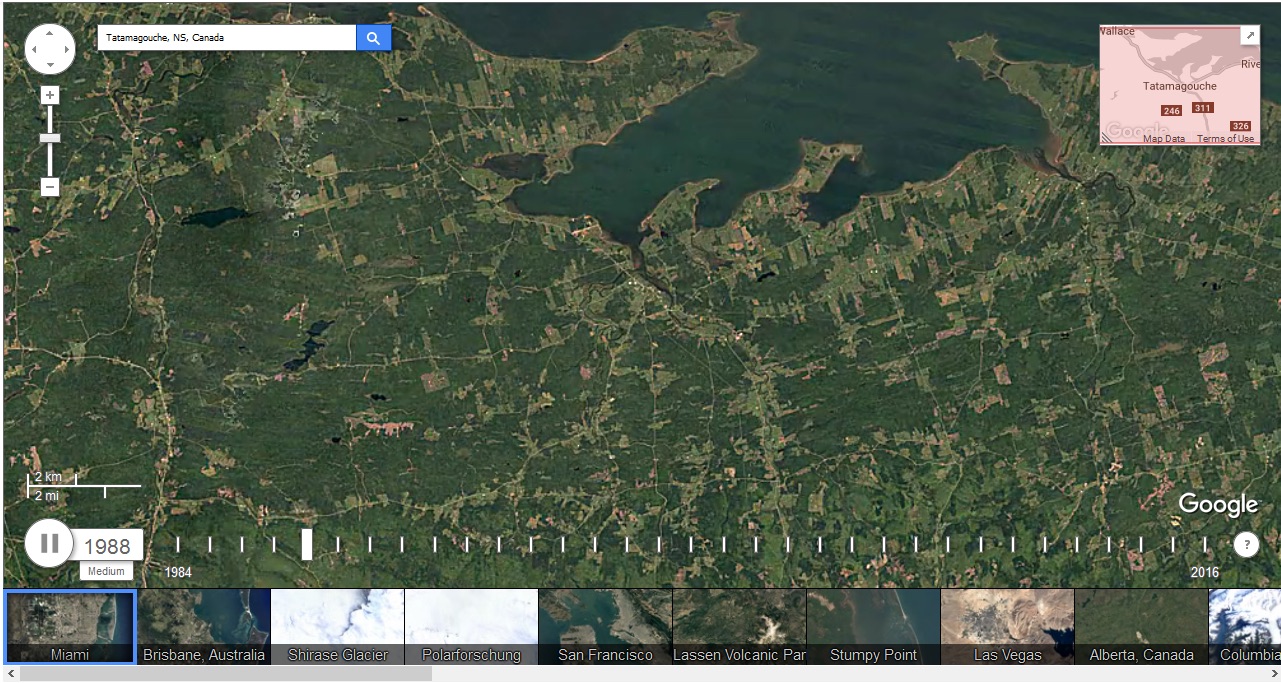
Google Timelapse, https://earthengine.google.
This is a sample image. Just key in the location in which you have an interest.
Posted in General Information
Comments Off on New Google environmental change tool