TREPA and TERRACYCLE

While Nova Scotia does recycle many forms of waste there are some that don’t easily make it into the recycle stream. However, an organization, Terracycle, takes many of these items and pays the group who collects them. For example, an inkjet cartridge is worth 25 cents. Organizations join Brigades that focus on different items as in the illustration below.

See: www.terracycle.ca for more information.

Posted in General Information, Waste Management | Comments Off on TREPA and TERRACYCLE

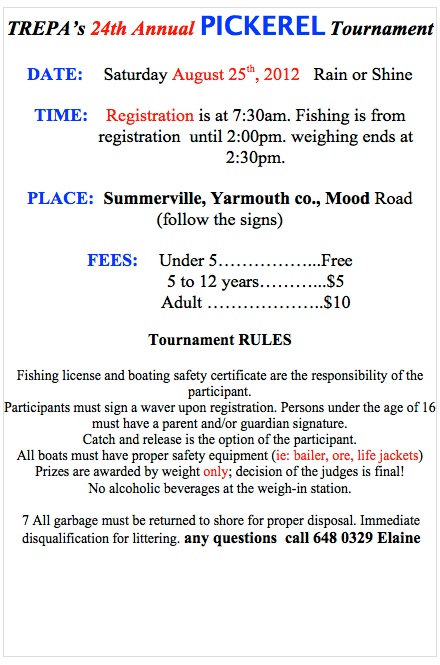
Pickerel tournament announced

Posted in Events | Comments Off on Pickerel tournament announced

Liberal position on aquaculture

The following was received as a response to TREPA’s letter on aquaculture previously posted.

Thank you for contacting me regarding the Liberal Caucus position on aquaculture.

Aquaculture is a successful and valuable industry in our province. With nearly 7,600 kilometres of coastline, Nova Scotia produces only a small percentage of aquaculture in Canada. There are many examples where aquaculture is used without incident and without consequence, bringing benefits to the local community and generating economic development. Recently however, there has been increased attention focused on this sector and questions about certain aquaculture projects in Nova Scotia. Many Nova Scotians from around the province have well-grounded concerns about possible adverse effects an aquaculture site may have on the environment and local eco-systems. While we support the aquaculture industry, we firmly believe that each site is different and must be looked at on an individual basis. That is why we fought against a proposed aquaculture site in Port Mouton Bay in 2007. In that instance, the proposed farm was too large for the area and would have negatively impacted the local environment and fishery operations. In 2010, we also called upon the current NDP government to strengthen regulations around aquaculture farms and communicate more effectively with Nova Scotians on this matter. We also encourage the government to look at what species and types of farms may be better suited to land-based systems rather than open water pens. Many Nova Scotians are not against aquaculture but want stronger regulations to safeguard our environment and resources.

The Nova Scotia Liberal Caucus recognizes that there have been incidents at some aquaculture sites in the province. The health of our environment is a principal concern for us; therefore, our Caucus is calling for a moratorium on the approval of new aquaculture sites until after government review is complete.

If you have further questions or concerns, please do not hesitate to contact our office.

Sincerely,
Stephen McNeil

Posted in Aquaculture | Comments Off on Liberal position on aquaculture

TREPA on aquaculture statement

To:
Stephen MacNeil, Leader, Nova Scotia Liberal Party,
Jamie Baillie, Leader, Progressive Conservative Party of Nova Scotia
Cc:
Premier Darrell Dexter
Stirling Belliveau, Minister of the Environment
Stirling Belliveau, Minister of Fisheries and Aquaculture
Zach Churchill, MLA, Yarmouth
Chris D’Entremont, MLA, Argyle
 
From:
John Sollows,
Executive Director,
Tusket River environmental Protection Association,
P.O. Box 103,
Tusket, N. S.,
B0W 3M0

Date: July 16/12

The various attempts to divide interested citizens into pro- and anti-aquaculture camps are a dishonest oversimplification of reality.

Aquaculture should certainly have an important place in the rural economy of Nova Scotia, but we need to give a lot more priority to the issue of sustainability than the current government is doing.

The current discussion needs to focus on open cage culture of salmon.

Salmon are carnivorous, for a start, and therefore widespread culture has the potential to put added pressure on wild “forage” fish species, which are used to feed the farmed fish. Furthermore, cultured carnivorous species tend to be expensive to grow, and have limited potential to feed poor, hungry people.

More particularly, the wastes from large scale open cage operations pollute, which can make problems for the farmed species, the environment around the cages, and the wild species which depend on this environment. Local resource users, such as lobster fishermen, are rightly worried about the dangers large-scale cage culture may pose to their livelihoods.

We recognize that salmon culture has economic potential, and encourage the government to take a serious look at land- based alternatives, wherein the wastes from the fish can be turned into another resource. As an environmental group, we oppose open cage culture of salmon; we are particularly worried that the government is encouraging the rapid expansion of some farms and the “dropping” of other good-sized farms into relatively pristine embayments.

Every embayment and every water body is unique. Expansion, if advisable, should be more by tenths than by tens, and whatever happened to pilot-scale testing? It is foolhardy to assume that a hundred cages in a harbour will perform the same as ten cages. As resources are consumed and wastes reach toxic levels, negative feedback should be expected.

There have, for instance, been salmon cages in Shelburne Harbour for quite a few years. Why did ISA show up this year? Looks to me like a shot across the bow of the expansionist boat.

Finally, I think policy-makers need to be reminded of a very important pair of questions, a pair which should influence every decision: “Who benefits?” and “Who pays?” If the answer to both questions is different, decision-makers could be promoting injustice.

Posted in Aquaculture | Comments Off on TREPA on aquaculture statement

Great news for Gillfillan Lake and CRK Allen Reserve

TREPA owns and maintains the CRK Allen Reserve on Gillfillan Lake. It is the property along the stream just after you cross the bridge. We are pleased to announce that the Nature Trust will be a new neighbour, just one property removed. Wouldn’t it be a nice joint effort to work to acquire the piece in between. I bet we could do that.

NATURE TRUST PROTECTS ENDANGERED SPECIES AND THE NEXT PIECE OF THE PUZZLE ON GILLFILLAN LAKE HALIFAX.

June 29, 2012 – Last night, the Nova Scotia Nature Trust announced the permanent protection of a 44 acre lakeshore property on Gillfillan Lake, providing critical refuge for one of Canada’s most endangered species, the Plymouth gentian (Sabatia kennedyana). The new protected area makes an important contribution to a larger network of conservation lands on the lake, together providing some of the last habitat for the species in Canada.

Gillfillan Lake, along the Tusket River in Yarmouth County, is considered one of the highest conservation priorities in Nova Scotia. It provides critical habitat for the endangered Plymouth gentian and a suite of other imperilled species found on only a few lakes in Nova Scotia, and nowhere else in Canada. The property’s shoreline also provides habitat for the sensitive tubercled orchid (Platanthera flava var. flava).

In 2004, the Nature Trust protected the first site for Plymouth gentian, through conservation-minded landowners Jeanne Lange and David Haskell. Both New York based actors, they treasured the lakeshore property as their summer escape for many years and were delighted to discover it was valuable not just to them, but for biodiversity conservation on a national scale. Following protection of this first site, the Nature Trust acquired the adjacent property in 2007. Yet another important site on the lake has been donated as a bequest to the Nature Trust and will become part of the protected lands network. Other conservation organizations, including the Nature Conservancy of Canada and the Tusket River Environmental Protection Association, have already protected parcels of land along the shoreline, and the Government of Nova Scotia is considering several other extensive parcels for protection under their 12% initiative (a commitment to protect 12% of Nova Scotia for conservation by 2015).

The Nature Trust’s newest acquisition builds on these achievements by protecting the latest piece of the puzzle in creating a continuous network of protected areas, providing an extensive sanctuary for some of the last of these plants. Together, the protected lands and proposed protected areas on the lake equal over 2,500 acres, providing approximately 9 kilometres of important shoreline.

Nature Trust’s Conservation Coordinator Cristi Frittaion said, “Nova Scotia provides some of the best habitat in the world for this plant to grow. The permanent protection of this property is important and timely, as cottage development and shoreline alterations continue to increasingly threaten the communities of plants in the area.”

The recent protection of this property was made possible by the Government of Canada through the Department of Environment, as well as the William P. Wharton Foundation, Ascenta, Aveda, and the Imperial Oil Charitable Foundation, as well as the generosity of Nature Trust supporters.

The Nature Trust made the new property announcement at their conservation showcase and annual general meeting held Thursday night. The event, held at the Nova Scotia Natural History Museum, celebrated the Nature Trust’s exciting conservation achievements, including protecting, forever, over 6,000 acres of Nova Scotia’s natural legacy for the benefit of all Nova Scotians.
Posted in Endangered Species | Comments Off on Great news for Gillfillan Lake and CRK Allen Reserve