TREPA visits Farmers’ Market

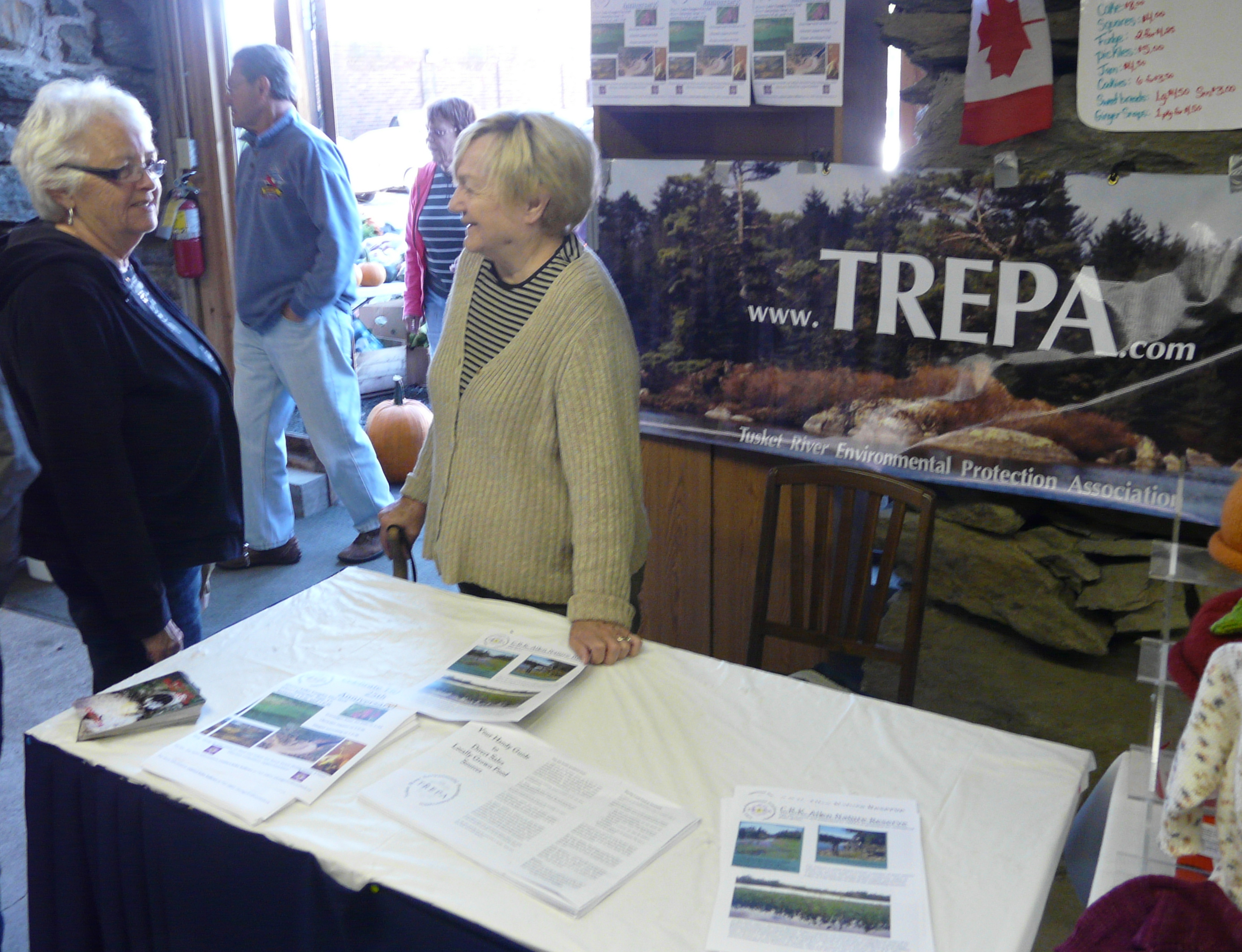
Aurel Mooney talks about TREPA at the market

TREPA had a community table at the Yarmouth Farmers’ Market on September 10th, 2011, to promote our 25th anniversary and generate publicity for our celebration on the 17th. We had volunteers helping with the table and gave our information on membership, the celebration, local food vendors and the CRK Allen Nature Reserve.

Posted in Events | Comments Off on TREPA visits Farmers’ Market

Lake George – TREPA supports town

The following letter was sent to the Ministers of the Environment and Natural Resources in support of the Town of  Yarmouth request for a meeting concerning  potential for mining in the Lake George Watershed, Yarmouth’s drinking water supply.
 
Date:  September 4, 2011
 File No: 11-063

 Dear Messrs. Belliveau and Parker:

 We support the concerns of Town of Yarmouth regarding the security of the town’s water supply, and the Mayor’s June 9 request for a meeting with you.

 Lake George is the water supply for the Town of Yarmouth and part of the Municipality of the District of Yarmouth.

 We would like to draw your attention to the Lake George Watershed Protected Water Area Regulations, made under Section 106 of the Environment Act, S.N.S. 1994-95, c. 1; N.S. Reg. 197/2006 (October 16, 2006).  Clause 15 states “No person is permitted to extract peat, gravel, rock, minerals, aggregate materials, top soil or any non-renewable resources within the Protected Water Area.”

 We are aware of the mining exploration licence granted to Greenlight Resources for field exploration  on the “Brazil Lake Lithium and Rare Metal Property.”  We wish to draw to your attention that the potential mine area overlaps the Lake George Watershed Protected Water Area.

 In light of this, (a) licence notwithstanding, any extraction within the Protected Water Area would violate the regulation in question, (b) we feel that the Town should have been consulted before this licence was issued, and (c)  considering the regulation and the importance of protecting a public water supply, we recommend that extraction of any sort should be expressly forbidden within the Lake George Watershed Protected Water Area.

 There should be no risk to a public water supply from a private enterprise, and the only way to assure this, in this case, is to follow the above regulation, with regard to actual mining operations.

 We trust that you will assure same.

Posted in Water Pollution | Comments Off on Lake George – TREPA supports town

Shelburne couple can appeal fish farm decision, court rules

From September 2, 2011 Chronicle Herald, Business Section. The judge’s reference to the fostering of community involvement in the management of coastal resources under the provincial Fisheries and Coastal Resources Act is encouraging.

By CHRIS LABIA Business Editor
Fri, Sep 2 – 4:54 AM

A Shelburne couple has convinced a judge that they should be able to appeal a decision that allowed a fish farm to be larger and closer to their property than first announced.

Marian and Herschel Specter, who live on the Shelburne Harbor waterfront, appealed a decision by Sterling Believe, the provincial minister of fisheries and aquaculture, to allow changes to three aquaculture licenses held by Kelly Cove Salmon Ltd. Believe had tried to have the couple’s appeal of his decision this past spring dismissed because it wasn’t filed within the 30-day time limit.

“Here, the appellants have an arguable case that the minister’s decision exceeded his jurisdiction,” Justice Arthur LeBlanc of Nova Scotia Supreme Court said in a written decision released Thursday.

“The respondents have not argued undue delay. Therefore, even though the appellants’ appeal was not filed in time, it should not be dismissed as untimely. The minister’s motion to dismiss the appeal on the basis of timeliness is refused.”

None of the fish farm sites shared boundaries with their previously approved locations, the judge said.

“There is also evidence that the sites may have a detrimental impact on other uses of marine resources, particularly in the intertidal zone,” LeBlanc said. “In these circumstances, there is an arguable case that the amendment procedure was not appropriate, and that the minister should have followed the procedure for granting new licenses.”

The closest of the three aquaculture sites was being moved to within about 240 meters of the couple’s property.

“In this case, the decision at issue authorized the movement of an industrial food production facility — an aquaculture fish farm — to within approximately 240 meters of an adjacent coastal landowner,” the judge said. “The owner of the fish farm admits that water clouding in the vicinity can occur, as well as increased algae and slime in the intertidal zone.”

Kelly Cove Salmon argued that the Specters lacked standing in the case. But the judge didn’t buy it.

He pointed out that one of the purposes of the provincial Fisheries and Coastal Resources Act is to foster community involvement in the management of coastal resources.

“The value of the appellants’ property may be impacted by this decision. The appellants’ use of the intertidal zone immediately adjacent to their property may also be impacted by this decision. This potential impact will affect the appellants in ways that are significantly different from the general public.”

( clambie@herald.ca)

Link to Fisheries Act:  http://nslegislature.ca/legc/statutes/fishand.htm

Posted in Aquaculture, For the Record | Comments Off on Shelburne couple can appeal fish farm decision, court rules

Hear CBC from Keji

CBC Information Morning – Live From Kejimikujik!

MAITLAND BRIDGE, NOVA SCOTIA, August 26, 2011

Parks Canada is excited to welcome CBC Radio, Information Morning, for a live remote broadcast at Kejimikujik National Park and National Historic site on September 2, 2011 from 5:55am- 8:37am at Kejimikujik’s Visitor Center. Visitors and guests are invited to join hosts Don Connolly and Louise Renault as they discover Kejimkujik in celebration of Parks Canada’s 100th birthday. Topics to be explored are Kejimkujik’s Dark Sky experiences, Mi’kmaq petroglyphs, the species at risk program and much more.

Throughout the show there will also be musical interludes by our own Parks Canada staff. In 2011, Parks Canada is celebrating its 100th anniversary as the world’s first national parks service. To recognize this occasion, Parks Canada is inviting Canadians to come celebrate at its places across the country. For more information about special centennial events and regular activities, please visit:

http://www.parkscanada.gc.ca/keji

Posted in Uncategorized | Comments Off on Hear CBC from Keji

TREPA responds to Environmental Act draft

The following is TREPA’s submission that has been sent to the Nova Scotia Department of the Environment related to their request for comments on the draft policy changes.

Date: August 29/11

TREPA’s comments on proposed changes are enclosed herewith, along with a few suggested changes, not mentioned in the notes.

In a nutshell, the changes proposed by the Department are positive steps. The workload of Inspectors should be lightened and their enforcement authority increased. The department was underfunded and understaffed before recent budget cuts, and we hope that cuts to the department can be reversed as soon as possible.

We agree with imposition of administrative penalties.

Our experience at this end of the province lead us to raise a couple of issues not covered in your proposed changes:

(1) Industrial level farming and aquaculture urgently need to be (a) defined and (b) classed as undertakings, subject to environmental assessments and the public consultation that that implies. We have proposed some concrete definitions in the attached document.

(2) Rural economic development in Nova Scotia needs to be managed on the basis of catchment area. This is a fundamental and wide-ranging issue, which requires attention by the entire government. Again, our proposed definitions are a concrete step in this direction.

We hope you find our comments useful.

Comments on NSE Environment Act Review

Most of the proposed changes make sense, and we will not comment on those with which we agree.

The emphasis on better enforcement is needed, as is workload reduction for overworked staff. More budget and more staff are needed for this badly under-resourced department.

Finally, we wish to point out the need to consider industrial farms and industrial aquaculture operations as undertakings automatically subject to environmental Assessments, and emphasize the need to manage rural economic development on the basis of catchment area.

Questions/ Concerns/ Comments.

1. Introduction: An “Advisory committee” will be consulted. In the absence of any reason to the contrary, the identity of the members of the Advisory committee should be public knowledge.

2. Goal 1: Match resources to level of risk to the environment and human health/
Standards or code of practice to replace approvals, at times, followed by audit, inspection, enforcement.

(a) This is fine, provided that reliance on standards does not lead to NSE taking action only after the damage is done.

(b) Are there other ways of freeing up NSE workers to enforce the Act?

3. Goal 2: Use resources more efficiently and effectively (too much paper, more emphasis on inspection and response to complaints)

(a) Proposal 2 (more flexibility to draw on expertise of independent experts and advisors; consolidate powers of Minister.) Should not give too much discretion to the Minister. The “requirement” to engage arm’s length input for certain cases should not be eliminated. The problem here could be that political pressure can override NSE workers’ advice.

(b) Proposal 4 (Eliminate timelines (with exceptions) and adopt service standard that provides … reliable expectation of processing time.) Could this mean that important, necessary or sensible timelines get ignored? Is there much of a difference between a timeline and a standard?

4. Goal 3: Strengthen protection for the Environment and Human Health. Clarify enforcement
powers.

Proposal 2: Create an offence for failing to comply with Protected Water Areas regulations

Needed badly. How does the Department currently deal with violations of Protected Water Areas Regulations?

5. Administrative Penalties.

Good. Examples of applications?

6. In general, steps taken to lessen the workload and increase the authority of NS Environment staff are badly needed, but this should not be used as an excuse to make further staff cutbacks. The Department is already badly underfunded and understaffed.

7. A concern with the Environmental Assessment Regulations:

Class I undertakings include (A) various industrial facilities, (B) various types of mining, (C) certain transportation projects, (D) certain energy projects, (E) various waste management projects, (F1) An undertaking that involves transferring water between drainage basins, if the drainage area containing the water to be diverted is larger than 1 km2, and (F2) An undertaking that disrupts a total of 2 ha or more of any wetland.

Our concern:

Industrial-level agriculture and aquaculture should be explicitly listed under (A), as an industrial facility subject to an assessment.

For the sake of argument, “Industrial agriculture” can be defined as animal rearing facilities whose rearing densities exceed those given in Table 5 of the N. S. Department of Agriculture Manure Management guidelines and if the farm and contiguous operations of a similarly intense nature exceed 2 ha. in area or if the farm and those of a similarly intense nature exceed 1% of the catchment area it/they occupies/occupy. “Similarly intense” means “exceeding the densities set forth in Table 5 of the Manure Management guidelines. Two farms would be judged “contiguous” if they are separated by less than 100 m.

“Industrial aquaculture” operations could be defined as those in which the farmed commodity is actively fed, and (a) if on land, the farm and contiguous operations of a similarly intense nature exceed 2 ha. in area or if the farm and those of a similarly intense nature exceed 1% of the catchment area it/they occupies/occupy, and (b) if on water, the operation and contiguous ones of a similarly intense nature exceed 2 ha. in area or the operation and those of a similarly intense nature exceed 1% of the area of the lake or embayment they occupy. “Similarly intense” means an aquaculture operation where the cultured commodity is actively fed. Two farms on land would be judged “contiguous” if they are separated by less than 100 m. Two farms in the water would be judged “contiguous” if they are separated by less than 500 m.

Our experiences in the Yarmouth area tell us that their EA regulations need tuning, with regard to intensive farming and aquaculture, and that is not included in the discussion paper.

8. The government must take greater account of the importance of managing by catchment area in its rural development plans. This is fundamental and cross-cutting, and probably cannot be addressed by the Act alone. We have tried to begin the process with the above regulatory suggestions.
Posted in Uncategorized | Comments Off on TREPA responds to Environmental Act draft