TREPA activity

The next TREPA road clean-up or beach sweep will incorporate a new approach – service and educational excursion all in one.

Posted in General Information, Waste Management | Comments Off on TREPA activity

Local communities oppose aquaculture sites

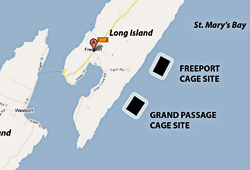
Location of aquaculture sites

HALIFAX – Local community members from St. Mary’s Bay and the Atlantic Salmon Federation today filed an appeal to the Nova Scotia Supreme Court to oppose the creation of one of the province’s largest fish farms in the community’s traditional fishing grounds.

Fisheries and Aquaculture Minister Sterling Belliveau’s approval in early June of two massive salmon feedlots received overwhelming opposition from local communities. The communities believe the feedlots, which will stock almost two million fish, will devastate their tourism and traditional fishing industries. The farms also threaten several endangered species, including the North Atlantic right whale, roseate tern, harlequin duck and wild Atlantic salmon.

“The appeal addresses whether the Minister had the constitutional jurisdiction to issue the licenses and whether it was reasonable for him to neglect communities concerns, gaps in the scientific evidence and socio-economic impacts,” said Ecojustice lawyer Hugh Wilkins.

Ecojustice is representing the St. Mary’s Bay Coastal Alliance, the Atlantic Salmon Federation, Freeport Community Development Association and the Villages of Freeport, Tiverton and Westport. The groups are calling on the government to revoke the licenses and to put the interests of the local communities before the province’s aggressive aquaculture development plans.

“Families have been fishing lobster here for generations,” says David Pugh of the Village of Westport. “It is well-paying, sustainable work that supports our communities. The arrival of these salmon feedlots will put an end to that, displacing the lobster fishery with lower-paying, unskilled jobs.”

St. Mary’s Bay is one of the richest lobster fishing grounds in the world and is being considered by Parks Canada as part of a significant new national marine conservation area.

“Evidence from similar feedlots in New Brunswick shows that they will significantly deteriorate the habitat for key commercially harvested fish and significantly displace and diminish the quality of the existing lobster fishery in the area,” said Karen Crocker of the St. Mary’s Bay Coastal Alliance.

“The Minister completely ignored the many concerns and comments of the individuals, communities and groups most affected by this project”, said Andy Moir of the Freeport Community Development Association.

“The cumulative impacts of new and existing fish farms in the Bay of Fundy are adding up”, said Bill Taylor, president of the Atlantic Salmon Federation. “Without sufficient consideration of the impacts of all these operations on endangered species, like wild Atlantic salmon, the Minister’s decision was clearly unreasonable.”

For more information, please contact:

Pierre Hamilton, communications associate | Ecojustice
416-368-7533 ext. 26

Sheldon Dixon, LFA 34 Lobster Fishermen | St. Mary’s Bay Coastal Alliance
902-839-2830

Rikki Clements | St. Mary’s Bay Coastal Alliance
902-839-2255

Karen Crocker | St. Mary’s Bay Coastal Alliance
902-839-2923

Andy Moir | Freeport Community Development Association
902-839-2337

Sue Scott, vice-president communications | Atlantic Salmon Federation
506-529-1027

Posted in Aquaculture, For the Record | Comments Off on Local communities oppose aquaculture sites

From the Bird Life International Newsletter

Thanks, Eric Ruff, for bringing this article to our attention.  Over the lives of long-term residents in the Yarmouth area, we have also seen changes.  Evening grosbeaks, grey jays, and boreal chickdees used to be common winter birds, but cardinals and turkey vultures were unheard-of.  How times change.

Is some tropical areas, many of the large species (notable vultures) are fast-disappearing.  Here is the tale of another recently-endangered species:

Big Birds Lose Out in a Crowded World

24 June 2011 – One of the world’s largest species of bird is on the brink of extinction according to the 2011 IUCN Red List for birds, just released by BirdLife International. The Great Indian Bustard Ardeotis nigriceps has been uplisted to Critically Endangered, the highest level of threat. Hunting, disturbance, and habitat loss and fragmentation have all conspired to reduce this magnificent species to perhaps as few as 250 individuals. Standing a metre in height and weighing in at nearly 15 kg, the Great Indian Bustard was once widespread across the grasslands of India and Pakistan but is now restricted to small and isolated fragments of remaining habitat.

“In an ever more crowded world, species that need lots of space, such as the Great Indian Bustard, are losing out. However, we are the ones who lose in the long run, as the services that nature provides us start to disappear,” said Dr Leon Bennun, BirdLife’s Director of Science and Policy. This year’s update brings the total number of threatened bird species to 1253, an alarming 12% of the world total.

Posted in Endangered Species | 2 Comments

June 22 monitoring trip to C. R. K. Allen Nature Reserve

TREPA owns the C. R. K. Allen Nature Reserve at the north end of Gilfillan Lake near East Quinan.  The Reserve includes a diversity of threatened Atlantic coastal plains flora, including a major plantation of the Plymouth Gentian along the lake shore.

The public is welcome to visit the reserve, but not on motorized transport, and to take only pictures and leave only footprints.

Here is President Margrit Robinson’s report from a visit she and her husband, Leslie, made this June 22:

On June 22, 2011 Leslie and I visited the CRK Allen Nature Reserve.  On the North side of the track to the reserve, on a tree, is a small plaque saying “Nature Conservancy, Natural Area, Owned and managed for conservation”, a 1-800 number and their website.

The monument is standing and in good condition.  There were fresh ATV tracks and where there is a permanent, deep puddle, a new track has been made around the puddle.  An elderly woman and a girl appeared on an ATV; they were delighted that “they have made a new path around the puddle”.  We talked to her, she was well aware of why the blocks were near the beach but did not seem to understand the bigger concept of conservation/preservation.  She mentioned that she has the pictures of the special flowers and took a photo of the woodfrog we spotted.  She was friendly and invited us to visit her at the cottage on Gilfillen Lake.  She mentioned that more driveways were gated now which would help to prevent people from riding through the brook.  They then rode on the “new path” to the bottom but not onto the spit.

On the shore there were the usual 2 fire pits, a frying pan, a shoe, a burned tent, including fiberglass poles (from last year), fresh fish remnants and we picked up a small amount of garbage.

There were tracks into the stream but no tracks around the spit or along the shore on the other side of the cement blocks.  The water was quite high, too wet to walk along the shore.

Posted in General Information | 1 Comment

A little recycle hint

For what it may be worth you can:

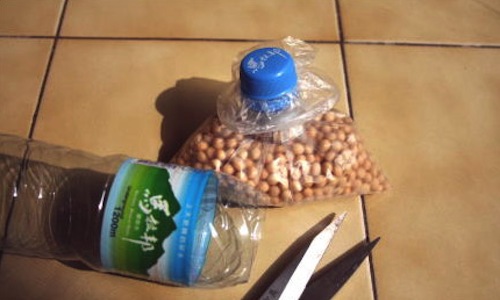
USE A BOTTLE TOP TO SEAL A PLASTIC BAG…..

It is water proof and air tight, probably better than a twist tie or rubber band.

Cut up a disposable water bottle and keep the neck and top.

Insert the plastic bag through the neck and screw the top to seal.

Posted in Waste Management | Comments Off on A little recycle hint