Three views on aquaculture

TREPA News is a open forum dedicated to informing our interest group and keeping a record of fact and opinion on environmental topics.  Aquaculture is in the news and should be part of our coastal management strategy. Here are several recent views on the topic.

For: Sterling Belliveau, Minister of Environment and Fisheries and Aquaculture sees it as a jobs issue.

Aquaculture means jobs for rural NSS.
By STERLING BELLIVEAU Thursday, June 16

Recently, there has been a lot of discussion and concern raised about aquaculture in Nova Scotia. The province has regulations and environmental monitoring for this industry. It is difficult to name another industry in Nova Scotia as closely monitored and scrutinized as aquaculture.

Regulations and monitoring ensure aquaculture is practised in an environmentally sustainable manner. Government veterinarians and scientific staff ensure that aquaculture sites are monitored and inspected regularly for fish health and environmental compliance.

The environmental assessment considers everything, including recreational and traditional uses of harbours and waterways, potential environmental impacts and site selection to minimize any possible displacement of traditional fisheries.

Licences, terms and conditions regarding the St. Mary’s Bay application are posted on our website. We are sharing the information we collect regarding aquaculture sites. Laboratory analyses are available to the public on request.

Nova Scotians have been, and will continue to be, consulted on aquaculture. People have the opportunity to provide input during community meetings, as well as the environmental assessment for individual operations. We also conducted a public opinion survey with almost 700 Nova Scotians. This survey tells us what people know about this industry, their environmental concerns, and their support for the jobs and economic benefits aquaculture creates.

Aquaculture is the fastest growing area of food production in the world. The aquaculture industry provides a great opportunity to create good jobs and grow the economy in coastal communities where they are needed. They operate year-round and provide an easy transition for traditional fishery workers. Aquaculture also creates local spinoff jobs in fields such as trucking, packaging, metal fabrication, and research and technology.

Nova Scotia is positioned to benefit from this growing industry. The government is working on a strategy to ensure that aquaculture continues to expand and grow in a well-managed way that will protect the marine environment and bring benefits to coastal communities.

Aquaculture contributes about $58 million to the Nova Scotia economy and provides jobs for 750 people. It has potential to become more than that. As aquaculture helps meet world demand for healthy food products, we can create jobs and economic benefits in coastal communities around Nova Scotia.

Against: Shelburne residents concerned. Violation of process and other issues.

By BRIAN MEDEL Yarmouth Bureau, Thursday, June 16

Shelburne summer residents Herschel and Marian Specter of Sandy Point have filed an appeal of the recent provincial government approval of what they allege are three new salmon aquaculture sites in Shelburne Harbour.

Papers were served Tuesday at the office of Fisheries and Aquaculture Minister Sterling Belliveau after the appeal was filed Monday at Nova Scotia Supreme Court in Halifax.
“Our lawyer has said that we should not be talking,” Marian Specter said Wednesday when asked to comment.

A website set up by the Specters, friendsofshelburneharbour.org, explains their viewpoint and includes a series of 18 newsletters for community members.

“It will show you the process that we went through,” Specter said.

The couple posted the newsletters, an average of one a month, telling folks their concerns about aquaculture goings-on in Shelburne.

Halifax lawyer Andrew Taillon represents the Specters.

“We’ve presented six different grounds under which we think the minister’s decision was unreasonable,” he said Wednesday.

One of the grounds for appeal alleges the minister treated the sites in question as amendments to existing sites rather than as completely new sites.

“We think there’s an issue here with regard to whether or not these are, in fact, brand new licences and leases” said Taillon.

Celeste Sulliman, a provincial Fisheries and Aquaculture Department spokeswoman, said Wednesday there are no new fish farm applications for Shelburne Harbour.

She said there are three existing sites there owned by Kelly Cove Salmon.
Kelly Cove Salmon is listed as a division of Cook Aquaculture Ltd. of New Brunswick.

“We found out about three proposed new salmon aquaculture sites in the inner (Shelburne) harbour,” Marian Specter said in an Ecology Action Centre news release issued Wednesday.

Taillon said the appeal alleges proper procedures were not followed.
“Our understanding and our allegation is that there weren’t any public community meetings held,” he said.

The appeal also alleges the licences violate provincial regulations in the Fisheries and Coastal Resources Act.

“We’re also alleging that the decision itself violates certain directives and guidelines that come from (Fisheries and Oceans Canada).”

Taillon said an informal notice was received in March but his clients had no copies of the decision until mid-May.

“We don’t know the date that the minister made the actual decision.”
A motion for directions is set for June 29 in a Halifax courtroom.

“All that’s going to happen there is the court will give directions in terms of what happens next,” said Taillon.

A government response is expected to be filed.

“It would not be our best practice to talk about it in the media,” said Sulliman.

“The minister won’t make any kind of public comment on any kind of legal action that we may be dealing with.”

The province acknowledges new aquaculture site applications have been filed in the region. They are for finfish leases at Blue Island and Jordan Bay in Shelburne County.
“We’re just starting the process on those,” said Sulliman.

Against: Bay St. Mary fishermen and supporters protest process and approach.

BILL POWER Business Reporter, Wednesday, June 15

Groups opposed to open-net salmon farms will be in Halifax on Friday with trucks filled with lobster traps they say will be permanently lost from inshore waters when Cooke Aquaculture proceeds with a couple of new salmon farms in St. Marys Bay.

“These groups are not opposed to aquaculture but to the establishment of open-net farms, which are at the bottom of the list in terms of environmental efficiency,” said Jordan Nikoloyuk, with the Ecology Action Centre in Halifax.

Nikoloyuk said the province should encourage the use of close-containment aquaculture systems that can be used in the water or on land.

Members of the St. Marys Bay Coastal Alliance and the Friends of Shelburne Harbour will participate in the Friday protest at Province House, beginning at 11 a.m.

The organizations are opposed to the province’s support of rapid expansion of industrial-scale salmon farms despite widespread community opposition, said Nikoloyuk.

“About 80 per cent of the residents of these communities are opposed to the salmon farms that were approved without public consultation,” he said.

Cooke Aquaculture of Blacks Harbour, N.B., has clearance from the province to proceed with two new operations at St. Marys Bay near Digby. The company has a couple of farms in the area and also has farms in Shelburne Harbour and in St. Margarets Bay at Bayswater.

“We are not new to Nova Scotia. We’ve been operating in these communities for about 15 years,” said spokeswoman Nell Halse.

Halse said she was just returning from a meeting the previous evening in Shelburne where about 300 people participated in an open house and about 80 per cent were supportive of Cooke expanding its operations in Nova Scotia.

The company wants to boost annual production in the province to the point that a processing plant would be viable, she said.

It is part of a planned $150-million expansion that could create more than 400 jobs.

“Most of the opposition comments we’re hearing are imported from the anti-salmon farming lobby on the West Coast,” said Halse.

She said the economics and environmental impact of converting all aquaculture of self-contained operations was unrealistic and unnecessary according to various studies and experts.

Cooke Aquaculture is a privately held family business with annual revenues in the range of $450 million.
Posted in Aquaculture | Comments Off on Three views on aquaculture

Town and Municipality get started on climate change strategy

Atlantic Climate Adaptation Solutions Workshops

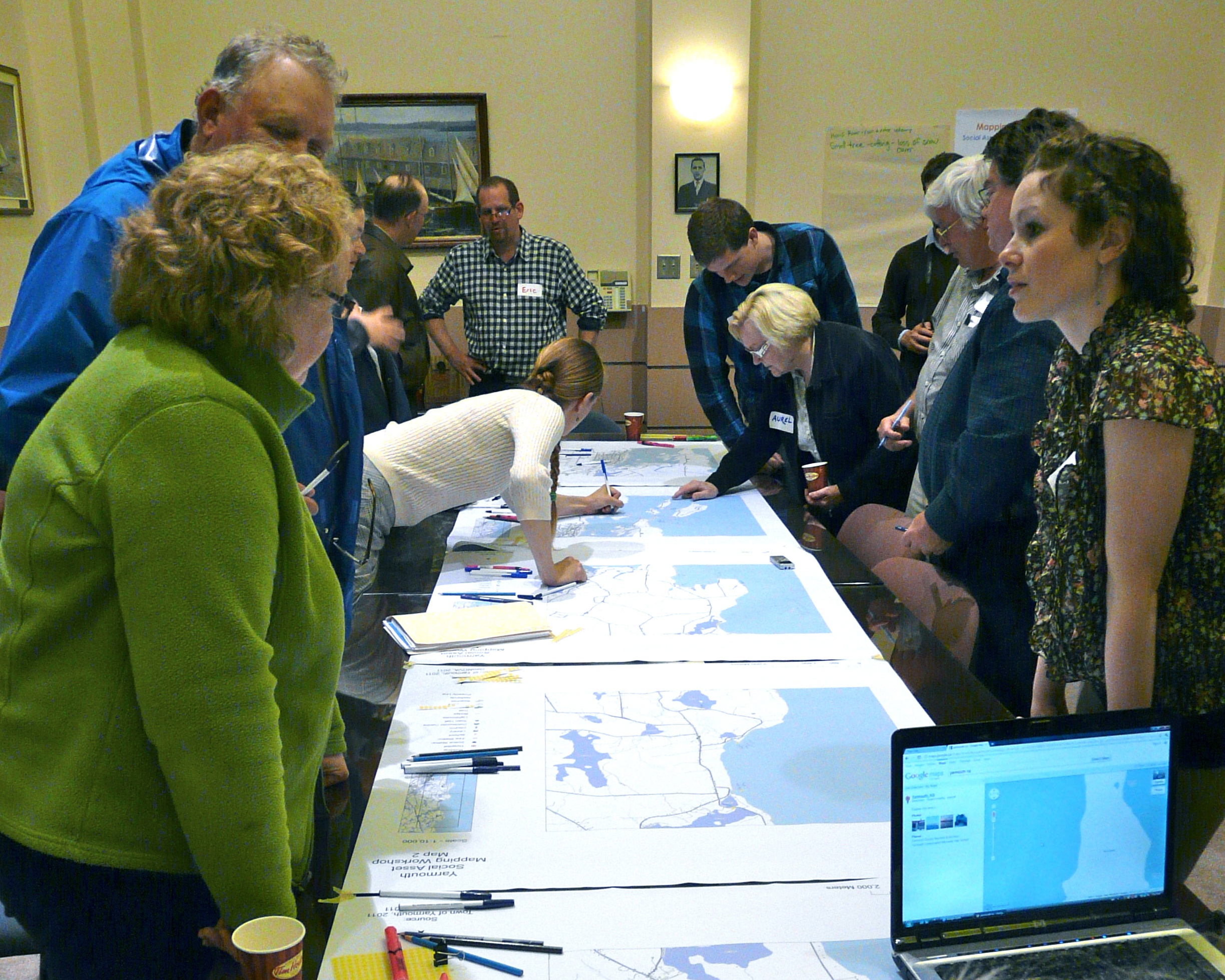
Residents add community assets to maps at Town meeting.

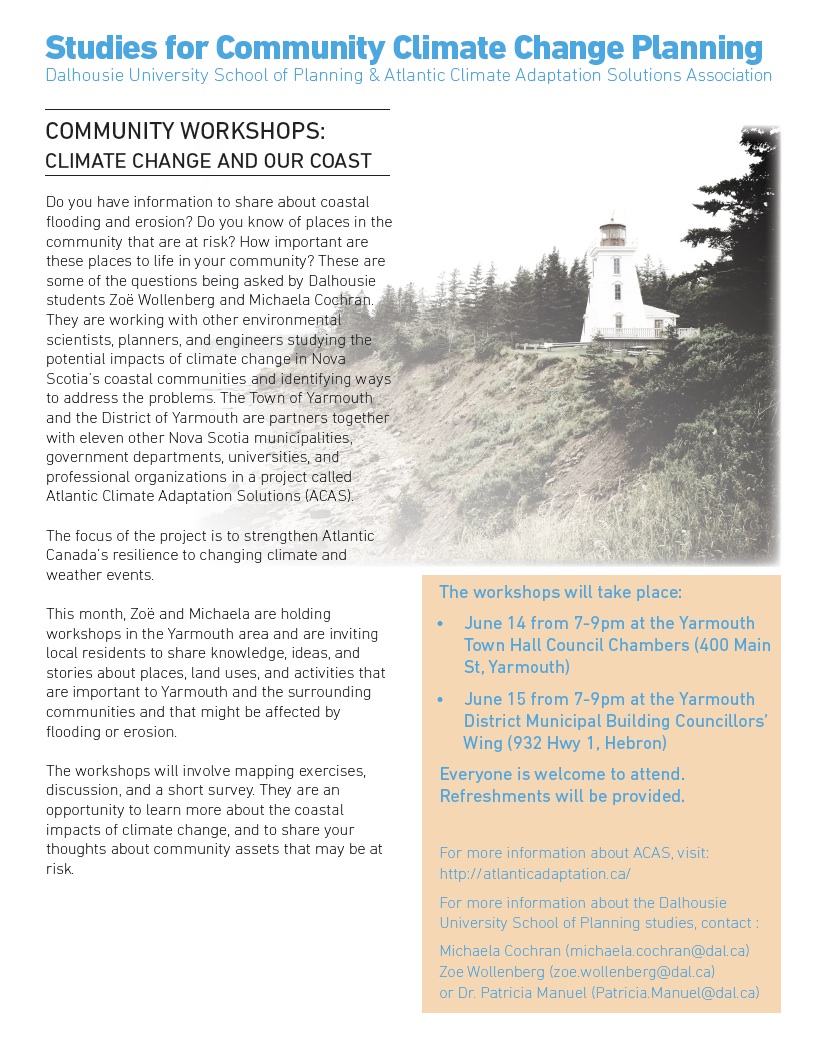
On June 14th at Town Hall and June 15th at the Municipal Building a team of students from Dalhousie met with local residents to begin mapping of assets that could be effected by the rise of sea level and weather events attributable to climate change. It was also disclosed that Nova Scotia is in a period on natural subsidence from long ago (10,000 years) glacial changes. So, if you are already seeing changes to the coast in your lifetime this could be a factor.

Okay. Climate change, habitat change, geographic change, is hard to grasp – we like things to stay the way they are. It is like growing old. It just takes place a little bit at time. For a quick understanding put a big pot of cold water on your stove and turn on the heat and stick your hand in the water. It will feel fine, even good for awhile. But, at some point …. you just won’t like it anymore.

These workshops were part of a research program carried out by the Dalhousie School of Planning, in cooperation with the Town of Yarmouth, Municipality of the District of Yarmouth, and TREPA.

The aim of the workshops was primarily to identify existing and potential impacts from sea level rise, storm surges,  and related increased erosion, with the ultimate goal of identifying ways of making our community more resilient to climate change.

The gathering on June 14 included about seven representatives from the University, three TREPA Board members, John Sollows, TREPA Executive Director, and seven other area residents.  A similar format and similar turnout followed the evening of June 15 at the Yarmouth Municipal building.

We were invited to discuss and map changes we have already seen and those we can predict from continued sea level rise.  Damage to wharves and other coastal fishery, tourism, and commercial infrastructure, roads, and backup of the town sewer system were among the major effects predicted.  The trip to the hospital may become considerably longer for most town residents.  What effect could a one-meter rise have on Tusket Dam?  Damage to historic sites and erosion of coastal farmland were also foreseen.  Effects on aquifers and water supplies may have started already; it was noted that one well on Cape  Forchu has already turned salt and some new drilled wells on the coast south of Port Maitland have a similar problem.

The mapping exercises and related discussion were a first step.  The team plans to visit later in the summer, and possibly focus more on potential responses to sea level rise. Ultimately, it is hoped that this research will help the town and municipality develop plans to cope better with climate change.


Posted in Climate Change | Comments Off on Town and Municipality get started on climate change strategy

Rally protests aquaculture expansion

Lobster fishermen and coastal communities bring salmon fight to Halifax
On Friday June 17th at 11:00am at the Nova Scotia Province House on Granville Street in Halifax.

Members of coastal community organizations and lobster fishermen will join the Ecology Action Centre to protest the Provincial Government’s support for the rapid expansion of industrial-scale salmon farms despite widespread community opposition.

Join the group on Friday June 17th at 11:00am at the Nova Scotia Legislature. We will hear from speakers from affected coastal communities, lobster fishermen and First Nations groups. We will be easy to find – look for the trucks full of lobster traps that can no longer be placed in the inshore waters where salmon farms will be built.

The recent decision of Sterling Belliveau, Minister of Fisheries and Aquaculture and the Environment, to approve salmon farm leases in St. Mary’s Bay threatens one of the richest lobster fisheries in the world and is a major step in Cooke Aquaculture’s expansion in Nova Scotia after the disease and environmental problems caused by their farms have limited their opportunities in New Brunswick. We need to act now to keep these large-scale aquaculture sites from ruining our coastal environments and fisheries.

Citizens from coastal communities are growing increasingly frustrated and feel they are being ignored by their elected officials. The St. Mary’s Bay Coastal Alliance and lobster fishermen from LFA 34 have repeatedly raised their concerns about open net salmon farms with Sterling Belliveau, Minister of Fisheries and Aquaculture and the Environment. They have been consistently ignored and dismissed and are traveling to Halifax to bring a strong message of opposition to open-net salmon farms in their community.

For more information call Jordan Nikoloyuk at 902-446-4840 or email jordan@ecologyaction.ca


Posted in Aquaculture | Comments Off on Rally protests aquaculture expansion

Climate change workshops in Yarmouth

Posted in Uncategorized | Comments Off on Climate change workshops in Yarmouth

Concern for Lake George water quality

The following letter to The Vanguard was sent early in June when concerns were expressed about the possible effect of a proposed mink farm on water quality in Lake George.

Here’s the letter again, followed by a response from the Minister of Agriculture


To: Vanguard

From:  John Sollows, Executive Director

Tusket River Environmental Protection Association
Tusket, NS
B0W 3M0.

Phone:  742-2802

date:  June 8/11

Your article, “Town exploring water concerns” is very alarming, if there is any risk that Lake George could be affected by any nearby economic development.

Mink farms have been implicated in the algal blooms in lakes along the Carleton River, and this has underlined the need for rural economic development to be managed on the basis of catchment area, not political boundaries.

I don’t know the location of the proposed mink farm, but if there is any chance that it would affect Lake George at any time in the future, it should not go in.   Talk of the town of Yarmouth locating an alternate supply of water to accommodate such an operation strikes me as beyond reason.  Why should the needs of the public have to be compromised for a private enterprise, to this extent?

If the Municipality of Clare has already granted the permit, I hope the Municipality has ascertained that it would have no adverse effect on Lake George at any time.  Even if the lay of the land and the underlying bedrock assure that runoff and affected ground water from the farm flow away from Lake George, there is still a bit of concern, considering the gull population these farms can attract.  Lake George does not need additional fertilizing.

If the farm does go through, we understand that the waste will be trucked away.  We hope that the destination for the waste can accommodate it, environmentally speaking.  The waste would need to be stored on impermeable surfaces; otherwise,  the risk of cumulative pollution applies.  Will monitoring and enforcement of regulations be adequate?

This is a job for the province, and at the political level.  I know the Department of Agriculture is hard at work drafting regulations, but in the meantime, this project should not be allowed to proceed if it puts the water supply of the town at risk, or if it can affect other important natural water resources in the area.

I hope our fears are groundless, but this issue is still worth discussing.  The economy is important, and mink farming has a place in it.  That said, but the obligation of governments at all levels to protect the interests of the public should be pre-eminent.

  ____________________  

Ref. #  M24

Dear Mr. Sollows:

I am writing in response to your June 8, 2011 email expressing your concerns over mink farm development and the potential impact on Yarmouth’s water supply. 

As you point out, economic development is important and fur farming has a place in it.  We must also consider the impact of any activity on our water resources.  The Department of Agriculture regulates fur farming activity through the issue of licenses.  We are currently drafting updates to the fur farming regulations and we will outline issues that developers must address in sighting and future monitoring these farms.

The draft should be ready for review this summer.  I look forward to your comments in regards to the steps you feel are necessary to enable economic development while protecting our water resources. 

Thank you again for expressing your opinion on this matter.

Yours truly,

John MacDonell

Minister of Agriculture


Posted in Water Pollution | Comments Off on Concern for Lake George water quality